
NOMATEN Winter School 2024 (CEA Saclay, France, November 5-7, 2024)
As part of the European NOMATEN teaming project, the 4th scientific school of the NOMATEN CoE dedicated to the multifunctionality of materials for industrial and medical applications, was held from November 5 to 7, 2024, at CEA Paris-Saclay at Neurospin.
Organized by ISAS (Institute of Applied Sciences and Simulation for Low Carbon Energies, DES) and the Joliot Institute (DRF) of CEA Saclay, with the support of the NCBJ and VTT teams, this school constitutes the second event of this type proposed by the CEA, following on from the 1st school organized in Paris in November 2021. This 4th edition focused on themes linked to materials for energies by considering new concepts and/or applications and environments, the optimized design of systems by considering the aspects of development, characterization, modeling and advanced solutions for radiopharmaceuticals and medical therapies. With a record number of registrants (101), made up of more than a quarter of young researchers, the majority from the NOMATEN CoE (doctoral students, post-docs) and experts from the CEA, NCBJ and VTT, this annual event aims to bring together the NOMATEN community in Materials science and Radiopharmaceuticals science, to highlight the research work of young researchers in particular, to exchange with experienced researchers, to strengthen already existing interactions and to establish potential new synergies. With a format similar to the first three schools (November 2021, Paris, France; September 2022, Espoo, Finland; November 2023, Otwock, Poland), this school was structured around 4 sessions of presentations and exchanges with some specificities, supplemented by selected visits to CEA installations in Saclay and Orsay.
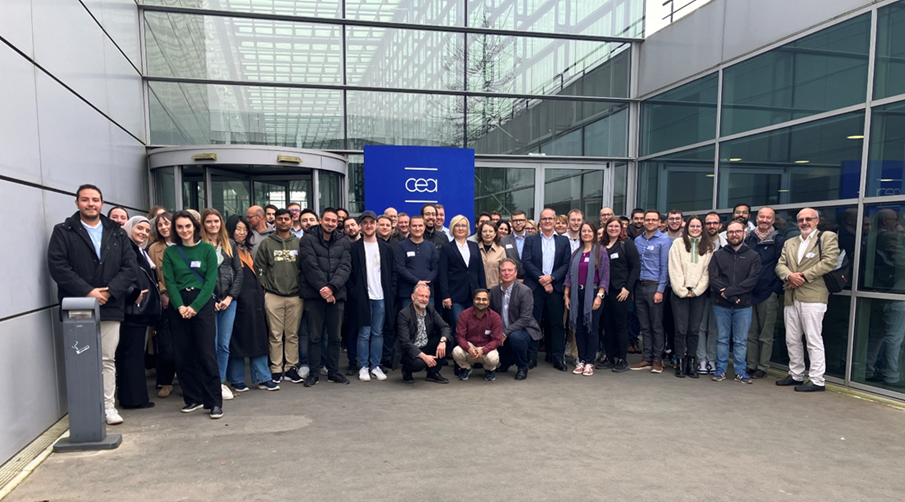
Participants of the 4th NOMATEN school
at CEA Saclay in Neurospin on November 5-7, 2024
Session 1, chaired by CEA, allowed us to revisit the objectives of the NOMATEN project and the center of excellence and to recall the main areas of activity of the partner organizations (NCBJ, VTT). This session also gave rise to four interventions by invited speakers: i) activities relating to SMR and AMR and the hybrid use of nuclear energy for the CEA/DES; ii) PET molecular imaging and the paradigm shift for clinical practice (CEA/DRF); iii) the use of RBS Monte Carlo pipeline codes for modeling the effects induced by irradiation (NCBJ) and iv) the opportunities offered by the production of hydrogen up to its use by integrating the material component (VTT).
Subsequently, session 2, chaired by the CEA and the NCBJ (NOMATEN) focused on nuclear issues of materials with in particular subjects dealing with large-scale representations of the local atomic environment to study the properties thermodynamics of point defects in HEA, the study of nucleation/growth regimes using near-field approaches in FeCr alloys, the study of helium bubbles at high temperature in concentrated WTaCrV refractory alloys, fatigue mechanisms in components in light water reactors, the implementation of laser cutting for dismantling operations, the analysis of materials via the LIBS technique, the study of melting limit microstructures and fracture behavior of welding alloy A52, IASCC in zirconium alloys and induced irradiation defects and associated hardening in ODS alloys in concentrated solid solution.
Session 3, chaired by the CEA and the NCBJ, was specifically dedicated to the presentation of doctoral student work from the various partner organizations in the form of “My thesis in 180 seconds” type presentations. Around twenty students presented their work in very varied fields ranging from the micromechanical properties of amorphous alumina-based coatings, to chemical potentials by machine learning for metallic glasses, including laser refinement of grains by ultrasound for laser powder bed fusion, copper-catalyzed nucleophilic radioiodination of new prosthetic groups, synthesis of new molecular tools for molecular imaging and therapy, high-speed dynamic recovery temperature of the irradiation microstructure and its impact on the mechanical behavior of zirconium alloys and the design of the composition of cobalt-free HEA alloys by semi-empirical methods. This session was also combined with a poster session (session 6) chaired by the CEA and VTT.
Session 4, chaired by VTT and NCBJ, was devoted to R&D on materials dedicated more specifically to non-nuclear fields. This session focused, among other things, on the study of corrosion markers incorporated by additive manufacturing for optimized component management, multi-scale modeling of alloys by digital image correlation and machine learning, the study of inorganic and hybrid halide perovskites, studies relating to the effects of material processing on their operation and maintenance, miniaturization and obtaining realistic toughness values, detection of dihydrogen via the use of distributed optical fibers, to the shear properties of CuZrAl metallic glass and finally to the description of the EU-MACE European Materials Acceleration Center for Energy programme.
Session 5, chaired by the CEA and NOMATEN, was devoted to R&D in the field of radiopharmaceuticals. During this session, the NOMATEN project partners addressed the boom in theranostics (winning combination of diagnosis and therapy) today, the contribution of imaging (PET) for the study of the distribution of drugs in vivo, its use in the context of neuroinflammation (and associated pathologies) but also the study of psychiatric disorders, the design and discovery of new (recombinant) antibodies, their chemical functionalization and their radiolabeling without forgetting the development of nanoparticles for multimodal imaging and targeted therapy. This session also made it possible to provide new information on the cellular response to high doses of radiation (external radiotherapy, FLASH), and to highlight the advances of the Center of Excellence in terms of new laboratories dedicated to radiopharmaceuticals (chemistry, radiochemistry, preclinical evaluation and imaging).
The last half-day was devoted to visiting three selected infrastructures: i) the SHFJ (DRF / JOLIOT, in Orsay), a center specializing in molecular and functional imaging, ii) the SAMANTA additive manufacturing platform and iii) LABRA (applied radiation laboratory for nuclear qualification), these two installations reporting to the DES, in Saclay. During the closing of the school, the VTT announced the organization of the fifth NOMATEN school, which should be held in Finland in Espoo in the fall of 2025 (September 30 – October 2, 2025).
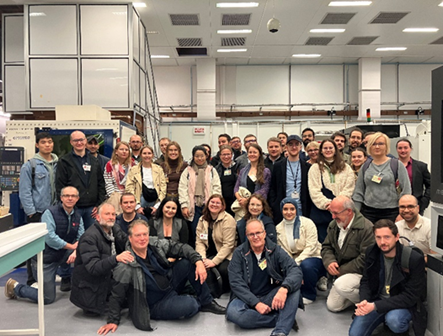
Participants of the 4th NOMATEN school at CEA Saclay visiting
the SAMANTA additive manufacturing platform (left)
and the LABRA laboratoty (right) on November 7, 2024


Tags